
The Los Angeles Protests Are an Act of Self-Defense

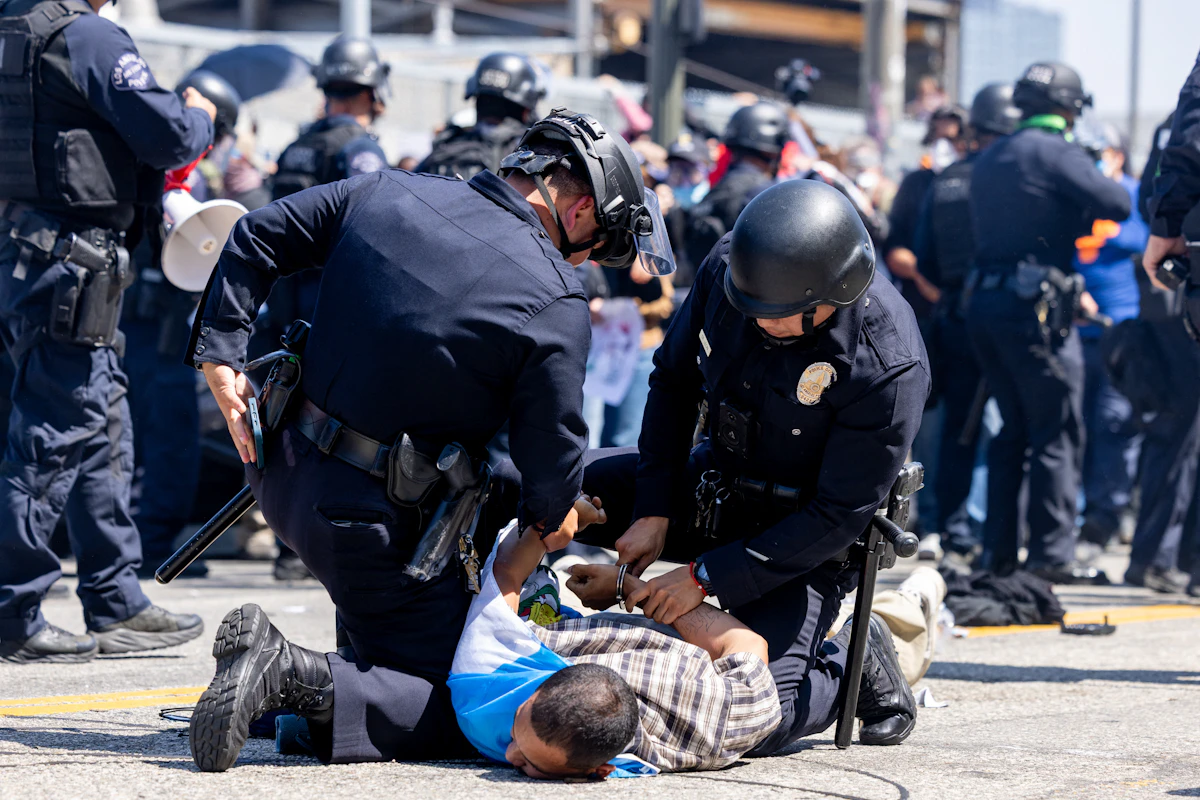
Early Sunday evening in Los Angeles, as the city was under siege by federal anti-immigration forces, aided by local law enforcement, Mayor Karen Bass was holding a press conference. Out in the streets, a reporter noted, it appeared that the Los Angeles Police Department was “cooperating” with Immigration and Customs Enforcement, “using flashbangs and less-lethal munitions” to push people engaged in “peaceful protest” away from a federal building being used as an ICE detention center. The reporter asked if Mayor Bass would comment on this cooperation, which is against city policy. “What happened there,” Bass began, “is that when one branch of law enforcement says they need help, another branch of law enforcement is going to respond.” In this case, she said, LAPD’s aim was to control the protest. She distinguished its actions from the department’s “coordinating with ICE in terms of raiding workplaces or arresting people who are undocumented.”
The Los Angeles mayor was trying to draw a line: While the LAPD is not supposed to be directly raiding workplaces or arresting undocumented immigrants alongside ICE, it is free to police the public so that ICE can raid workplaces and arrest undocumented immigrants. For those in the streets, choking down tear gas and dodging disabling “less-lethal” bullets as they try to defend themselves and one another from violent raids, this is a distinction without a difference.
Angelenos mobilized this weekend, after ICE descended on their city and over several days began making very public arrests. Last week, people arriving at their mandatory ICE check-ins at a federal building were instead quickly locked up in a makeshift detention center, where as many as 200 people were being held in basement rooms. (“No food. No water. Locked in holding rooms for over 12 to 24 hours,” said Democratic Representative Jimmy Gomez, who represents parts of Los Angeles.) Dozens of people were arrested at a Home Depot on Friday by masked agents in tactical gear. Multiple federal agencies assisted ICE. One witness described unidentified agents descending on food vendors nearby: “They were just grabbing people. They don’t ask questions. They didn’t know if any of us were in any kind of immigration process.” Another witness said that he was in his car when ICE agents stopped traffic, “in all their military gear.” People in the traffic jam could see ICE putting people into vans. “We weren’t there to protest,” the man told KCAL-TV, but when people got out of their cars and began to record with their phones, they were tear-gassed. As ICE agents raided a business in the Fashion District, footage of some community members challenging them indicates, LAPD was apparently stationed outside. And as the news of the raids spread, and more people came out to witness and protest, LAPD was there to push back, to control, to demobilize.
For Bass, it seemed, the problem was not that the LAPD was violently policing those protesting ICE raids; the problem was Trump’s calling in the National Guard to do the same thing. By this logic, the ICE raids, conducted with the support of myriad federal agencies, are a terrifying abuse of power that police should not collaborate in—but it’s fine for police to collaborate by keeping protesters and witnesses away. The upside-down thinking goes even further: It’s wrong for the National Guard to put down protests against the will of the governor and city officials, but it’s fine for state and local law enforcement to do it, so long as state and local officials want them to. The line of reasoning is maddening, seemingly designed to scramble and demobilize support for the people of Los Angeles. Accept the terms of the debate, and you end up in a bizarre argument about how much violence, from which armed agents of the law, is acceptable.
Originally published by newrepublic.com. Syndicated material does not necessarily reflect the views of Vanity Fair Fashion.


