Eastern Medicine Is Not (and Never Has Been) an
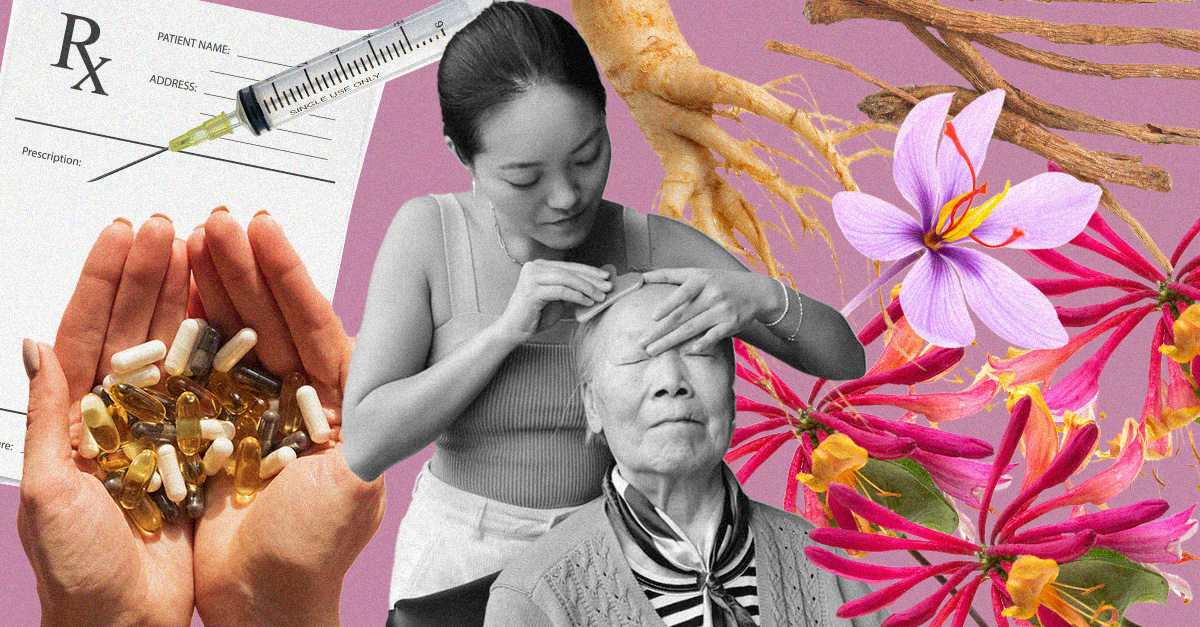
Stephanie Zheng's Instagram comments are a lot less brazen than the early days of launching Mount Lai, a skincare brand inspired by her own grandmother's gua sha and jade-rolling rituals. "In the beginning, we were getting a lot of, 'Oh, it's just a rock. Oh, that doesn't work. Oh, it's a scam,'" the licensed aesthetician recounts. "When people don't understand the practice and how it works, they're very quick to write it off." These days, as people in the West become more educated on the transformative benefits of gua sha, she thankfully doesn't see so many of these comments outright. (Though, there may be one or two naysayers hiding behind an anonymous username.)
Yet outside of the algorithm exists a slight—so small you might not catch it—that downplays many ancient Eastern modalities (gua sha, as well as acupuncture, breath work, herbal remedies, and other time-honored practices). People might not call them a "scam," but they may dub them "new age," or "woo-woo," or perhaps the most seemingly benign of them all: "alternative medicine." Language is powerful, and terms like these can function as a subtle dig—a wink-wink, nudge-nudge that Eastern medicine is not all that credible, when it's actually one of the oldest, most established systems of care in the world. For thousands of people for thousands of years, Eastern medicine is not an "alternative"—it's been the only medicine. So why would we ever position it, subconsciously or otherwise, as unserious?
According to board-certified dermatologist Asmi Berry, DO, FAAD, Western medicine prioritizes results—take the pill, treat the symptoms—whereas Eastern medicine isn't so performance-based. This inherently creates a dichotomy: "We think of Western as medicine and ancient practices more as wellness," she notes. To be clear, in no way am I (or is Berry) suggesting we disregard life-saving drugs, treatments, and procedures. That's the very problem here, isn't it? Rather than elevating one over the other, we should recognize both Eastern and Western medicine as valuable, comprehensive systems of healing.
"My grandparents were actually both Ayurvedic physicians, and my father was a cardiologist trained in the Western system. So growing up, I got to see both," Berry adds. "In my practice I say, 'Okay, this is your condition. This is the Western medicine to treat it and get rid of the symptoms, but let's pair it with these ancient practices so that you can prevent it from coming back once we get rid of it with the quick-and-fast method."
And make no mistake, Eastern medicine procures results—perhaps not as immediately as we're used to in the West, but powerful results that work in harmony with your body. "Back in the day in China, you would actually go see your acupuncturist the season before you get sick," shares board-certified doctor of Chinese medicine and licensed acupuncturist Debbie Kung, DAOM, LAc. "So if I didn't want to get sick in the fall, I would start going in for sessions in the summer to build my immune system. [I'd] do some cupping, do some herbal medicine."
This is because Eastern modalities, such as traditional Chinese medicine (TCM) and Ayurveda, honor the body's natural healing process—and not everyone follows an identical timeline. "Eastern medicine is a bespoke medicine. We treat your body how you come in, at the time that you come in, and where your body is at that exact moment," Kung adds. "If you're coming in super stressed, if you're coming in with health issues, if you're coming with trauma stuck in your body, it's going to take a lot longer to see results. It's going to more sessions."
That doesn't mean you should approach Eastern modalities with a "more is more" mentality. In fact, Kung says that most TCM practitioners are quite conservative when it comes to prescribing treatments, namely herbs. Yes, they're all-natural, but herbs are medicine—and they should be treated as such. Ashwagandha, an herb used for centuries in Ayurvedic medicine, has been shown to alleviate stress and anxiety symptoms. Ginseng, an herb with deep roots in TCM, has antibacterial properties that can enhance immune function. "Saffron is probably my favorite , not only because of the benefits on the skin but because there are some incredible mood-elevating properties," adds Ranavat founder Michelle Ranavat. Point being: Herbal medicine has some serious benefits—but again, it's not for everyone.